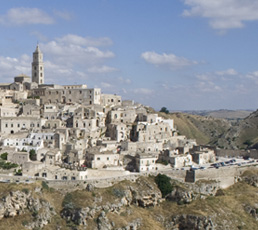
The town is known worldwide for its “Sassi”, recognized in 1993 by UNESCO as World Heritage. They are original and ancient clusters of houses carved into the limestone, near a deep gorge, the Gravina.
The Sasso Barisano, turned north-west edge of the cliff, if we take as reference the Civita, the center of the old city, is the richest. The Caveoso, looking to the south, is placed like a Roman amphitheater, and perhaps takes its name from the quarries and classical theatre. In the centre a rocky outcrop , called Civita, separates the two Sassi. You can find the Cathedral and the palaces above it. Together they form the old town centre of Matera.
The Matera Sassi is a settlement resulting from various civilizations and human activities over thousands of years. They date from a prehistoric Neolithic village, that was the habitat of an oriental rupestrian civilization, which is the substratum of urban Sassi, with its walkways, piping, tanks.They had a further development into a western-Norman Swabian civitas, with its fortifications, till the expansion during Renaissance,when some baroque buildings were built.
Matera has great importance in the production of traditional typical handicrafts , especially popular with the working of paper mache, pottery, and wrought iron.
 mycerchiara